"Twas the night before Christmas and all through the house, not a
creature was stirring, not even a mouse." Well, not exactly! Deep
within the carpets, upholstered furniture and mattresses, millions of
microscopic dust mites were busy going about their daily routines.
Huge populations of these tiny creatures, as many as 1,000 per
teaspoon (1 gram) of house dust, were doing their best to clean up
our world, eating shed human skin scales and secretions, house dust,
fungal spores, pollen grains, plant fibers and insect scales.
There are two species of house dust mites, belonging to the genus
Dermatophagoides, that are found in North America. They are
members of the arachnids family, which also includes spiders,
chiggers and ticks. Being 1/200" to 1/250" long, they are so small
that they are virtually invisible to the naked eye. They really are not
very photogenic, in fact, most people are repulsed by their
appearance. Thomas A. E. Platts-Mills, MD, PhD, Director, University
of Virginia Asthma and Allergy Disease Center, has made a career
out of these minute creatures and has come to appreciate them. "If
people were all taught about (dust mites) in high school, the whole
grossness would disappear. If you see the real thing, they are really
quite sweet," says Dr. Platts-Mills. "I love them."
A Closer Examination of the Dust Mite
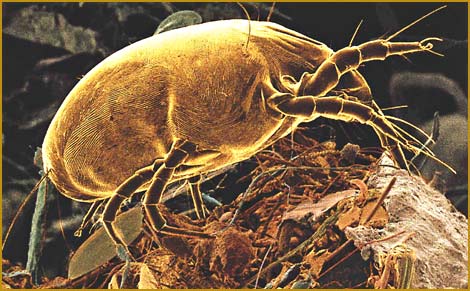
The dust mite's mouth parts are grouped in front of the body,
resembling a head. Their body is oval and covered with fine
striations. Their eight tiny legs have small sticky pads which enable
them to burrow deep into carpet fibers and furniture, easily resisting
the pull of even the most powerful vacuum cleaners. You definitely
would not want to turn over in your bed and find yourself face to
face with one of these strange looking creatures. Unfortunately, that
is where their populations are often the highest. The average bed
can easily have over 10,000 dust mites living in it. Dust mites do
not bite, sting or transmit diseases, so they pose no harm except to
people who are allergic to a protein they produce. Their numbers
have increased dramatically in the past 20 to 30 years, especially
during the winter months, partly due to tighter homes where
ventilation is limited and temperatures tend to be warmer.
Egg-laying female mites can increase the population by 25 to 30
every three weeks. They go through five stages in their life cycle;
from egg, the larvae stage, then two nymphal stages, and finally the
adult. The adult may also molt once. This cycle from egg to the
adult takes about one month. Adult mites can live up to two
months, depending on the humidity levels and temperatures of their
environment. They do not drink water but they absorb moisture from
the air and their environment. They just love higher relative
humidities of 70-80% and temperatures of 75-80 degrees F in which
their development and food consumption increases.
Dust Mites Produce a Powerful Allergen
It is the protein DER p1 in the fecal products and disintegrating body
parts of these minute dust mites that has a mighty adverse effect on
those who are allergic to it. Dust mites produce about 20 pellets per
day, each measuring about 10 to 24
µm (micrometers - formerly microns)
in size. To put that in perspective, the diameter of the human hair
measures 80-100 µm. A gram of dust can hold 250,000 of these minute
droppings. They are so tiny and light that they float easily into the air
when disturbed by our daily activities. Inhaling these minute particles
causes allergic reactions in those who are sensitive to this protein.
Allergens from the dust mite which cause asthmatic symptoms was
first suggested in 1921 but analysis of dust did not happen until
1964 when a group led by Voohorst suggested that a mite may be
responsible for the dust allergen. It was soon established that the
dust mite droppings contain an allergen so they became a focus over
the years for their involvement with respiratory ailments. The DER
p1 produced by the dust mite is though to be the most important
allergen associated with asthma. About 10% of the population are
allergic to dust mite extracts.
Identifying the Sensitivity to Dust Mite Protein
House dust contains many types of debris, including fabric fibers,
human skin scales, human and animal dander, bacteria, cockroach
parts, mold spores, food particles and other organic and synthetic
materials. About 90% of the people who are allergic to house dust
extracts are allergic to dust mite extracts. Symptoms which may
come from sensitivities to the dust mite protein include sneezing,
congestion, itchy, watery eyes and persistently stuffy nose and ears.
Symptoms point more specifically to dust mites when you experience
repeated sneezing shortly after awakening, symptoms get worse
when beds are made or when using your vacuum cleaner, and
improve when you are outside. Diagnosis, using scratch tests, etc.,
by an Allergist is recommended to determine which allergens cause
reactions. These doctors who specialize in treating allergies can
recommend a course of action specifically designed to reduce or
eliminate your allergic reactions. This may include steps for reducing
exposure to troublesome allergens, medical therapy and
desensitization injections (Systemic Immunotherapy - SIT). The latter
may be recommended if avoidance and medical therapy fail to
sufficiently reduce the allergic reaction. It involves injections of a
dust mite extract starting weekly, followed by injections every six
weeks for three to five years.
Importance of Reducing Exposure to the Dust Mite Allergen
If your family is not sensitive to the dust mite protein DER p1,
managing them may not be a high priority. For those who suffer
from it, management by reducing exposure to the allergen DER p1 is
quite important. Two important aspects which need to be addressed
are the removal of environments which are conducive to dust and
dust mites and the reduction of airborne dust mite droppings and
disintegrating body parts. Inhaling these minute particles causes
allergic reactions in those who are sensitive to this protein.
The exposure level at which you experience allergic reactions is
determined by the sum of exposure to all allergens you're sensitive
to. Those who are sensitive to multiple allergens find that reduction
of exposure to any of the allergens will help in their tolerance of all
the allergens. It is important to realize that you do not need to
completely eliminate exposure to allergens. Simply keeping your total
exposure of all allergens below the threshold at which you experience
reactions is all that is necessary.
Reducing Exposure to Allergens in Your Bed
Due to the amount of time we spend sleeping, our bedrooms are the
areas which deserve the most attention. Simply turning over in bed
or breathing near your pillow can cause you to inhale minute dust
mite droppings. Using hypo-allergenic fiberfill pillows is
recommended over feather, kapok or foam since they are more easily
washed. Encasing your pillows, mattress and box spring with plastic
or specially coated or finely woven (pore size < 10 µm) vapor-
permeable fabrics will deprive the dust mites of food and prevent
many of the dust mite droppings from reaching you. The fabrics are
more comfortable since they allow perspiration vapor to be more
naturally carried away from your skin. Thorough vacuuming the
mattresses, especially the seams and bed frame on a regular basis is
also helpful. Wash your sheets and mattress pads in soapy water at
130 degrees F every one or two weeks to kill all mites. Bedding and
curtains which can withstand frequent washing should be selected.
Blankets can be dry cleaned or washed frequently. Using an electric
blanket for eight hours every day can reduce dust mites in beds
significantly. Heating blankets in a cloths dryer for several hours also
kills mites. By doing this, dry cleaning or washing of blankets can be
reduced to once a year.
Reducing Exposure to Allergens in All Your Rooms
Wall to wall carpet and upholstered surfaces can be reduced or replaced
with hard surfaces that are easier to clean. Dust mites can not survive
long on hard surfaces due to dehydration. They absorb water through
contact with their environment. Dusting with a
HEPA filtered vacuum cleaner or specially
treated cloths is recommended over damp mopping. The latter may increase
the humidity in the house. Dust mites can't live at humidities below 50%.
Using air conditioners and dehumidifiers during the summer to keep the
humidity between 40% and 50% is often recommended. During winter, if using
a humidifier, be careful to keep the humidity in this same range. A good
humidity gauge can help monitor this. Carpets that get damp on a regular
basis should be replaced with hard surfaces.
Having carpets professional cleaned with superheated steam will
effectively killing dust mites in them. Carpets can be treated with
sprays containing 3% tannic acid to make dust mite droppings non-
allergic. Benzyl benzoate powder which actually kills dust mites is
also available. Reduction of contact with dust mite droppings is
often preferred since these contain toxic chemicals which some
people are sensitive to.
Reducing Exposure to Allergens with Air Filters
Wearing a well fitting dust mask while vacuuming and making beds
can reduce the dust mite allergens you inhale. Some allergists even
recommend airing out a room really well after vacuuming to reduce
the airborne particles which are stirred up by many vacuum cleaners.
Furnace mounted and portable air cleaners are available but their cost
may be greater than the benefits achieved by them. They definitely
are not a substitute for the preventative measures described above.
The best are media type filters like those which meet the stringent
HEPA specification. Electrostatic filters are not recommended unless
cleaned regularly in which case they may be as effective. Special
filters can be placed on the furnace air vents leading to your rooms
to help trap allergens before they can enter the room. Air cleaners
which generate ozone should be avoided since they have little effect
on allergens in the air and may worsen allergy symptoms since the
ozone may irritate the respiratory system.
Importance of a HEPA Filtered Vacuum Cleaner
The vacuum cleaner is one of the most important tools for managing
dust mites and their minute droppings. Thorough cleaning of carpets,
mattresses, upholstered furniture, curtains and drapery regularly will
reduce the dust mite allergens in your home. It is better to clean
thoroughly once a week instead of lightly every day. In order to
prevent these minute particles containing allergens from being
recirculated into the air you breathe, a vacuum cleaner's filtration
system must be very efficient at trapping particles at least that small.
The agitation and air flow created by your vacuum cleaner to clean
you surfaces causes a huge number of minute dust mite dropping to
be drawn into it. They can easily pass through most vacuum cleaner
bags and filters and be exhausted back into the air you breathe,
making it much dirtier than before. The vacuum cleaner industry is
taking advantage of the development of advanced filtration media to
provide much higher quality exhausted air than was possible just a
few years ago. The current cutting edge in vacuum cleaner
technology is in the area of improving the filtration efficiencies of
vacuum cleaners. Special high filtration paper bags are available
from many manufacturers which filter much better than conventional
ones. To learn more about these high filtration paper bags, see our
article on the Dustbag Performance and Filtration
Efficiency.
To reduce the effects on allergies and asthma caused by the allergens
in dust mite droppings, look for a vacuum cleaner with a
HEPA filter. It also is very important to
have a completely sealed system so all air flow must pass through the HEPA
filter to be cleaned by it. By combining high filtration paper
bags, a Certified HEPA filter and completely sealed systems, vacuum
cleaners can achieve extremely high filtration efficiencies of 99.97% at
0.3 µm (micrometers - formerly
microns) size particles. For more information
about HEPA filtration, see our article titled
"Filtration Efficiency - HEPA, Micron, etc."
Summary
Dust mites are microscopic creatures which live at peace with all of
us, constantly going about their routine of cleaning up our
environment. Unfortunately, for about 10% of the population, the
protein DER p1 in their minute droppings causes allergic reactions
which affect their respiratory systems causing allergic reactions and
triggering asthmatic attacks. A visit to an doctor specializing in
allergies (allergist) can confirm which allergens you are sensitive to.
They are able to prescribe a course of action which may include
steps to reduce the allergen exposure, medication therapy and
possibly desensitization injections.
Key steps to reduce exposure to dust mite allergens include encasing
mattresses and pillows, washing bedding and curtains regularly,
controlling humidity in you home and cleaning thoroughly with a
powerful high filtration vacuum cleaner. In extreme cases, carpets
and upholstered surfaces should be replaced with hard surfaces
which are easier to clean and which inhibit dust mite growth. The
goal is to reduce allergen exposure to below the level at which
allergic reactions occur, not necessarily the elimination of all
exposure to the dust mite allergen.
The vacuum cleaner is one of the most important tools for managing
house dust mites and their minute droppings. Our site contains
feature articles describing a number of powerful vacuum cleaners
which incorporate very efficient Certified HEPA filters in
completely sealed systems. These include
Models by Miele
and Models by Lindhaus.
Vacuum cleaner Models by SEBO have S-Class
filtration which is the european equivilant of HEPA.
Use of one of these is very important in reducing airborne allergens
during and after cleaning
your rooms. They can actually improve the quality of your indoor air,
making it smell fresher and feel cleaner.
Next Removing Allergens Article: Stop Childhood Asthma